Say Hello to AWS Cost and Usage Reports Integration and Report in CloudQuery
We've got some news that might make your finance team happy. Today, we're thrilled to announce our brand-new AWS Cost and Usage Reports (CUR) integration and Report for CloudQuery.
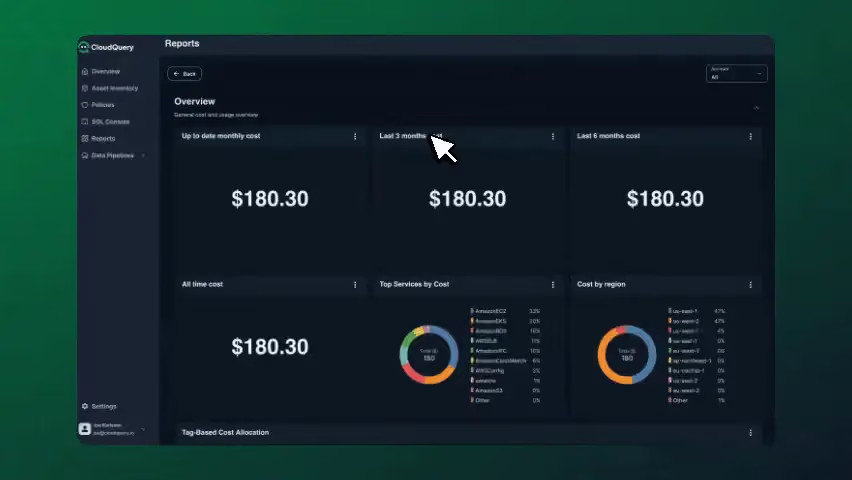
We know trying to understand AWS bills can feel like trying to decode ancient hieroglyphics. You know you're spending money in the cloud, but figuring out exactly where and why often turns into a month-long investigation.
AWS Cost and Usage Reports gives you the raw data about your cloud spending. But raw data alone isn't enough – you need the tools to actually make sense of it all.
That's where CloudQuery steps in.
Cloud Cost Management is an Engineering Problem, Not Just a Finance Problem
We fundamentally believe that cloud cost management is primarily an Engineering problem, not a Finance problem. Why? Because the real drivers of cloud costs are engineering and architectural choices. Cost should be a core aspect of making intentional engineering decisions, right alongside performance, reliability, operability, observability, and security. Only Engineering is capable of driving material, long-lasting cloud cost controls.
The reality in many organizations is that FinOps is making a good run at doing Engineering's job in managing costs, but that can only work so well. No engineer wants to hear questions from Finance about resizing instances, whether they really need those new EBS volumes, or whether certain S3 objects can be moved to Glacier. And yet, here we are.
The uncomfortable truth is that Engineering is often unintentionally abdicating responsibility. In many cases, Engineering teams have competing priorities, too few staff, inadequate tooling, and various other challenges preventing them from truly owning the cost of their systems.
The problem with a cloud bill isn't simply that it's large. The real problems are that the bill is:
- Opaque and hard to understand
- Unpredictable and seems to have runaway growth
- Gives leaders a pervasive feeling of not being able to influence it
We designed our AWS Cost and Usage Reports integration specifically to address these challenges by putting cost analysis tools directly in the hands of engineering teams. This creates an opportunity for improved relationships between Finance and Engineering.
With the CloudQuery AWS Cost and Usage Report integration, you can:
- Break down the AWS billing black box: Query your cloud costs just like any other infrastructure data
- Connect costs to resources: Link spending directly to the actual resources in your environment
- Create custom cost allocation: Build reports tailored to your business needs without spreadsheet gymnastics
- Eliminate data silos: Bring cost data alongside security, compliance, and inventory data
- Find hidden spending: Identify forgotten resources that keep draining your budget month after month
See It In Action
Let's look at a real-world example. Want to find your top 10 most expensive EC2 resources? Easy:
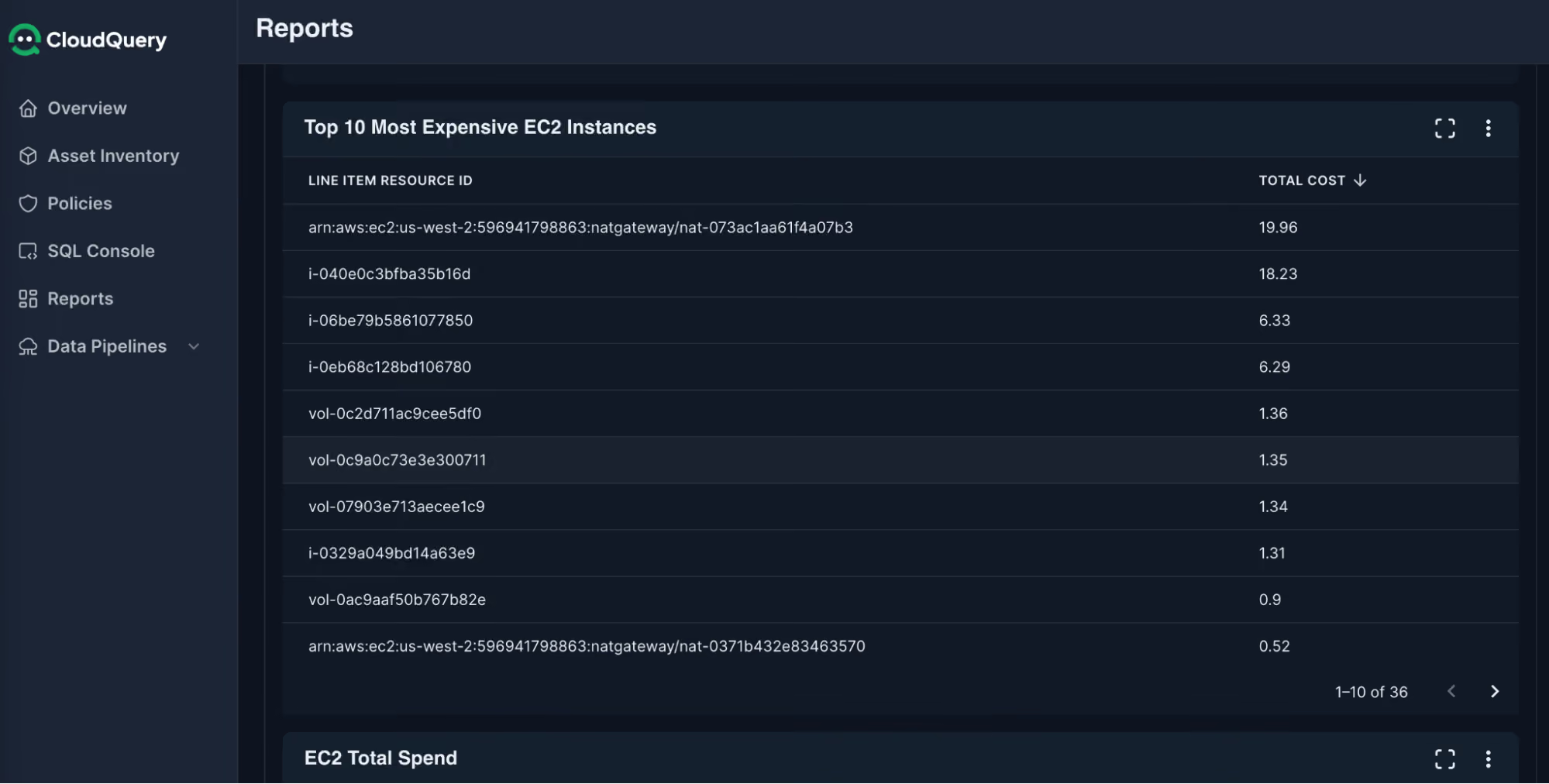
This gives you a clear view of where your EC2 budget is going, by resource ID and instance type, so you can make informed decisions about rightsizing or retiring expensive resources.
But that's just the beginning… How to see Tag-Based Cost Allocation (e.g., by Team or Environment)
While resource-level cost visibility is valuable, the real power of this integration comes when you combine cost data with your existing assets inventory. One of the most powerful applications? Team-Based Cost Attribution. By leveraging your existing tagging strategy, you can map cloud costs directly to the teams responsible for them:
S3 Storage Cost by Bucket
Identify expensive S3 buckets for potential data lifecycle optimization.
How to spot cloud services with Cost Increase > 50% month over month (MoM)
Spot sudden cost jumps across your AWS services?
Getting Started
Ready to take control of your AWS costs? Check out our AWS Cost and Usage Reports Integration documentation to get started today.
This is just the first of many cost-related integrations and reports we're building. We think this is one of the best ways we can help you save money while getting a holistic view of your cloud infrastructure, making CloudQuery the most versatile, customizable cloud governance and visibility platform possible.
The best way to understand how CloudQuery transforms cloud cost visibility is to see it in action with your own data. Our team would love to walk you through a tailored demo based on your specific cloud environment and use cases. Let's talk about how CloudQuery can fit into your stack and start saving you money right away. 👉 Schedule a demo today.
Stay tuned for more reports coming soon. And as always, we'd love to hear what additional reports or integrations would be most valuable for your team!
Written by

Try CloudQuery yourself
Self-hosted, open source, and free to start. Or schedule a demo to see the managed version.