Introducing Full-Text Search: Find What You Need in Your Cloud Inventory Instantly
You know that feeling when you need to track down an IP address or a security group during an incident? The clock is ticking, and you're frantically searching through dozens of tables trying to remember which ones might contain what you're looking for.
We've all been there. And frankly, it's a problem that shouldn't exist in 2026.
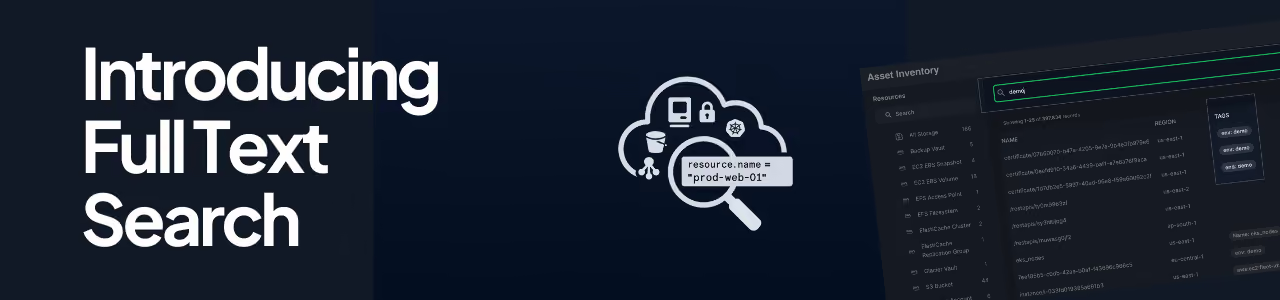
That's why we built the full-text search for CloudQuery. It's simple: search across your entire cloud asset inventory with just a few keystrokes.

Why We Built Full-Text Search for CloudQuery
Time and again, we heard from our customers about the same challenge:
An engineer at one of the largest financial institutions in the country put it perfectly:
The reality is that cloud infrastructure has grown incredibly complex. When you're pulling data from AWS, Azure, GCP, and a dozen other sources, the sheer number of tables and relationships becomes overwhelming.
Nobody wants to write complicated queries or memorize complex data structures, especially during critical situations like troubleshooting or security incidents.
How It Works
Full-text search in CloudQuery lets you find any string across your entire inventory. Type in an IP address, hostname, security group ID, tag name—anything—and instantly see all resources that reference it.
The search works with exact matches, partial word matching (like finding "Kubernetes" when you search for "kube"), and you can combine searches with filters for more precision.
For example:
- Find all resources with a specific hostname pattern (like "
prod-*") across your entire infrastructure. - Locate all resources that reference a particular subnet or CIDR range to evaluate the impact before making changes.
- Find every resource configured with a particular AMI ID to quickly identify affected systems after a vulnerability announcement.
- Track down resources using deprecated API versions that need updating before end-of-life deadlines.
- Search for resources with specific IAM roles or policies attached to audit permission boundaries.
- Locate all resources with specific configuration settings (like encryption disabled or public access enabled).
- Find all resources linked to a particular developer or team using name references in descriptions or metadata.
The results are automatically sorted by relevance, showing you the most important matches first based on where your search term appears.
Beyond Just Finding Things
Full-text search isn't just about locating resources faster. It's about changing how you work with your cloud infrastructure:
- Faster incident response: When alerts fire, immediately find affected resources
- Simpler auditing: Quickly locate resources that match specific compliance criteria
- Better visibility: Discover unexpected connections between resources
- Less cognitive load: Stop memorizing table structures and column names
What's particularly powerful is that, unlike many other cloud tools, CloudQuery search works across all your connected platforms. One search spans AWS, Azure, GCP, Kubernetes, and any other source you've connected.
While we've only recently launched full-text search, customers are already reporting significant improvements in their workflows:
A security engineer at one of our customers was investigating a potential issue with a security group. Before full-text search, this would have meant combing through EC2 instances, load balancers, and RDS instances separately.
Another customer's infrastructure team has dramatically reduced their mean time to resolution for incidents. When problems arise, they can quickly answer the critical question: "What's affected?"
Wrap up
The true impact of full-text search becomes clear when you use it with your own data. Current CloudQuery Platform users can access this feature immediately.
Not using CloudQuery yet? Schedule a demo with our team or take CloudQuery Platform for a spin yourself to see how it can transform your cloud infrastructure management.
About CloudQuery
CloudQuery is a developer-first cloud governance platform designed to provide security, compliance, and FinOps teams complete visibility into their cloud assets.
Ready to see how CloudQuery can transform your cloud visibility? Our team can walk you through a tailored demo based on your cloud environment and use cases. Let's talk about how CloudQuery can fit into your stack. Schedule a demo today.
Written by

Try CloudQuery yourself
Self-hosted, open source, and free to start. Or schedule a demo to see the managed version.