Introducing CloudQuery Insights: Cloud Intelligence That Connects the Dots
Your cloud inventory is growing faster than your team can make sense of it, driven by faster development cycles and AI-assisted engineering.
At the same time, cloud teams are expected to do more with less. From governance to cloud waste to security, the mandate is clear: keep your cloud estate safe, efficient, and compliant.
That mandate is much harder to execute than it sounds. Security findings live in CSPMs that security teams control, configuration state is scattered across cloud provider consoles and tools like AWS Config, and cloud teams find themselves combing through event logs, compliance tools, and Jira tickets just to answer simple questions.
Each tool has a piece of the picture, but no tool has the full picture. That gap is where risk and waste hide. We built CloudQuery Insights to close it, helping cloud teams identify and reduce the hard-to-find, but incredibly costly, risk and waste within their cloud.
What Is CloudQuery Insights?
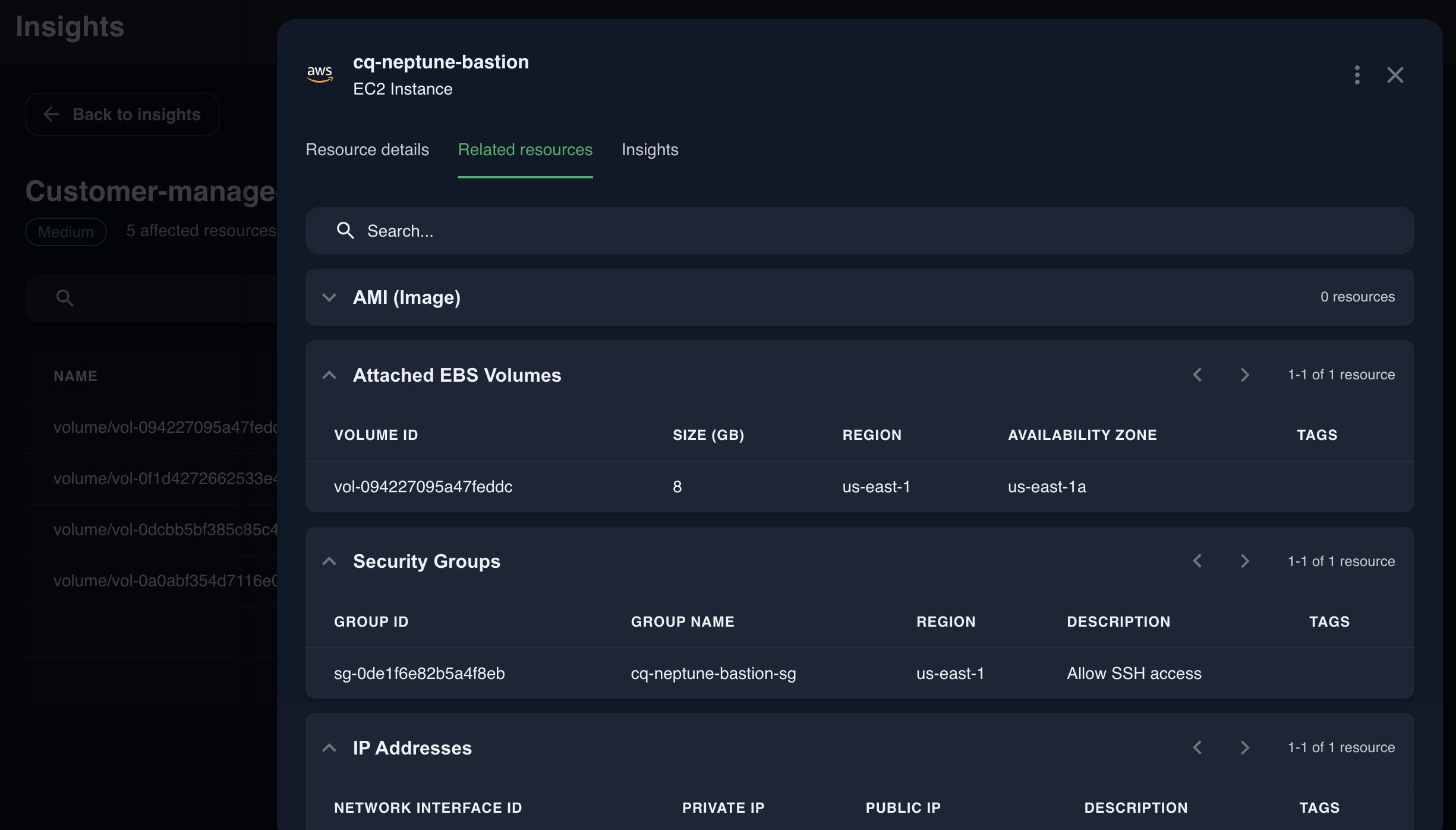
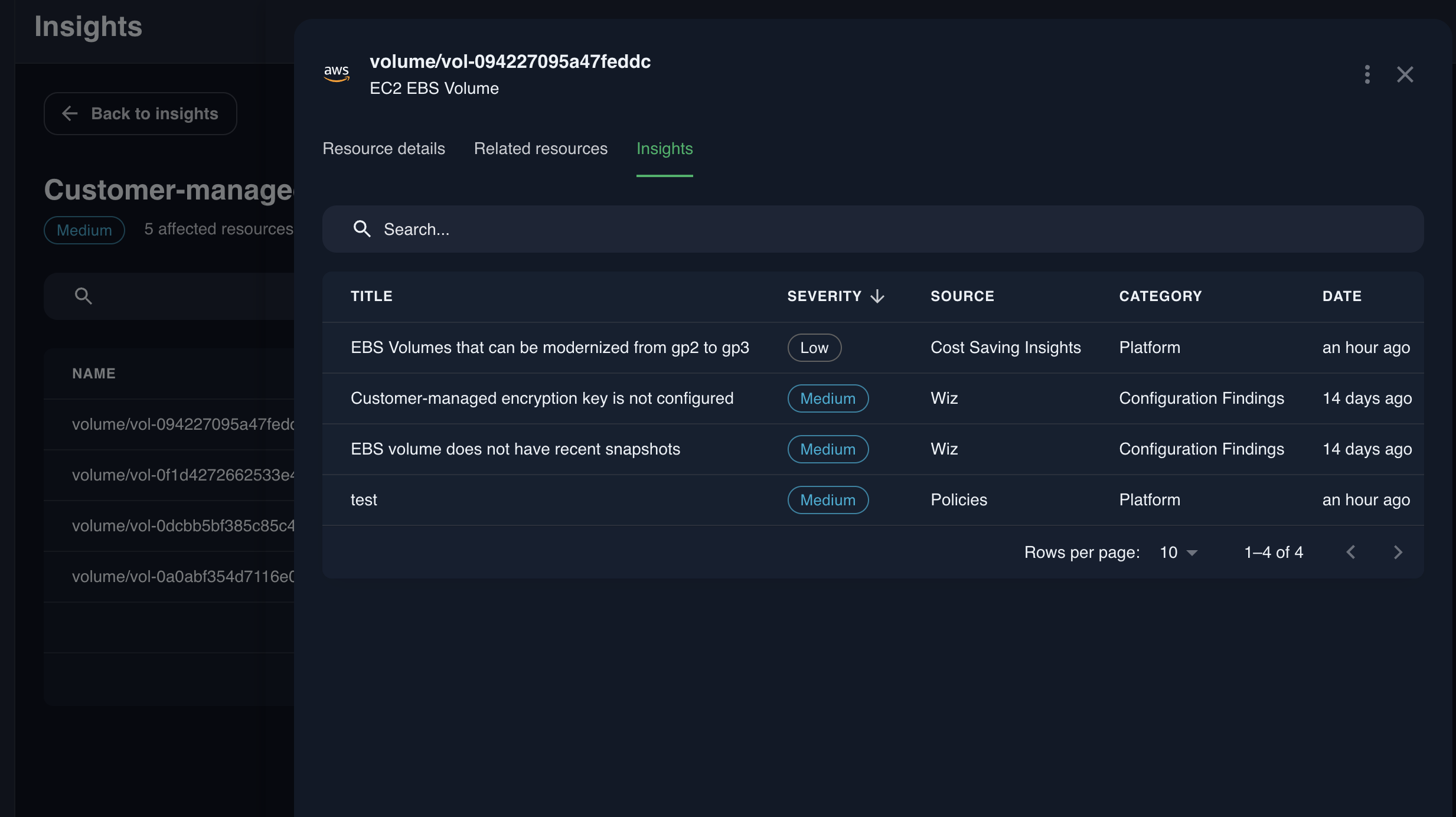
Insights monitors your entire asset inventory and automatically surfaces connected signals across your infrastructure. Security findings, cost data, policy violations, audit events: every resource is tracked and correlated simultaneously, without anyone having to go looking for it.
Here's a concrete example. Say you have an S3 bucket that's publicly accessible, contains PII flagged by Wiz, hasn't been accessed in 47 days, and was created by a contractor account. Today, discovering all four of those facts about a single resource means logging into multiple tools, cross-referencing data manually, and hoping you don't miss something. Insights presents all of that context together, on a single resource, automatically.
The difference between "this bucket is public" and "this bucket is public, holds PII, is abandoned, and was created by a contractor" is the difference between a finding and an actionable decision. That's what Insights delivers.
Why Did We Build This?
Cloud governance teams have data. Tons of it. The overwhelming CSPM list (welcome to findings hell!), AWS CUR, Config, Jira, GitHub, ServiceNow: the problem has never been a lack of information. The problem is connecting it.
When a team spots what looks like a misconfigured resource, they need to ask: is it actually a problem? To answer that, they need to check the security posture in one tool, pull up the cost data in another, find the owner in a third, and check the event history in a fourth.
That investigation can eat dozens of person-hours, and that's for a single resource. Multiply that across hundreds or thousands of flagged items, and teams end up in one of two modes: either triaging manually and burning out, or ignoring findings because there's too much noise to act on.
Both of those outcomes are bad. We wanted to build something better.
How Does Insights Change Day-to-Day Work?
The short answer: less hunting, more acting.
Triage is already done. Instead of your team manually investigating whether a flagged resource is a real problem, Insights pre-correlates the signals that matter. The context that used to take hours to assemble is already there when you look at a resource.
Policy enforcement becomes real. When a policy violation surfaces alongside cost data, ownership information, and historical events, it's a lot harder to dismiss. Your team can see the full picture and make a call, not guess.
Audit and compliance prep shrinks. Auditors ask questions that span multiple systems. Insights connects those systems for you, so your team spends less time pulling data together and more time answering questions.
Incident investigation becomes less painful. When something goes wrong, blast radius matters. Insights shows you what's connected to the affected resource: who created it, what policies it violates, what other resources share the same configuration patterns, so your team can scope the problem and respond.
What This Means for Cloud Teams
For cloud leaders: Your infrastructure footprint is growing exponentially, and the lack of a unified asset inventory means your team can't keep up. While point tools may give you a piece of the picture, they are often missing the critical context from other tools that could have helped prevent an incident, a vulnerability, or a costly budget overrun. We built CloudQuery to help your teams surface and act on the risks and waste that you care about and are measured on: faster, easier, and more efficiently than with cloud information silos.
For practitioners: We've been building CloudQuery around a core belief: cloud teams shouldn't have to stitch together a dozen tools to answer basic questions about their infrastructure. Insights is the next step in that direction, reducing the toil and fatigue that distracts you from value-driving work. It takes the connected, full-context data layer that CloudQuery already provides and puts intelligence on top of it, automatically surfacing the things that matter so your team can spend less time investigating and more time making an impact.
If your cloud is a liability and your team is drowning in findings from tools that don't talk to each other, or spending more time triaging than fixing, Insights was built for you. Bring your existing CSPM, FinOps, and engineering tooling and we'll show you what connected cloud intelligence looks like.
Written by

Try CloudQuery yourself
Self-hosted, open source, and free to start. Or schedule a demo to see the managed version.